Sunday, September 27, 2026

Schools Should Help Students Navigate AI, Not Ban It

By Akankshya Swain & Lira Roome at The 74

"'Today we will be writing an in-class essay.' It was fourth period English class, and the high school student was shaking, looking at the blank screen as the teacher explained the surprise exam. Writing essays should be common in high school. Yet between the start of high school and now, this young woman began relying on ChatGPT to assist with her writing.

A blank document had become intimidating, not because she had nothing to say, but because she forgot how to say it alone.

That scene from one of our classes underscores the unique challenge our generation faces as the first to grow up with artificial intelligence being a part of everyday life. High school students across the country share the struggle of navigating education with this new technology."

Read “Schools Should Help Students Navigate AI, Not Ban It”

Sunday, September 20, 2026

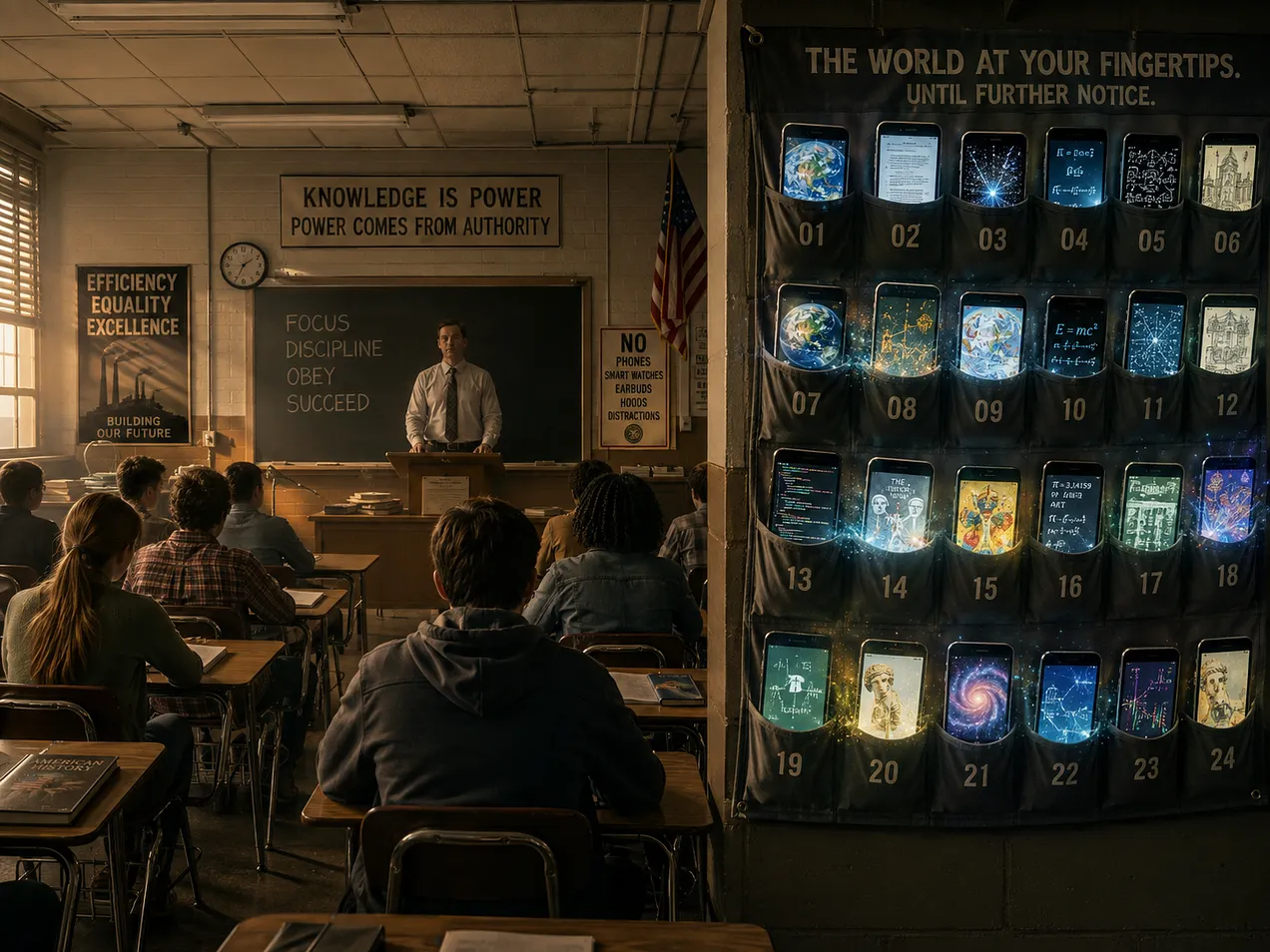
Banning Edtech Is the Wrong Response to the Right Questions

By Jennifer Carolan, Steve Kupfer, and Tony Wan at Reach Capital

"Nary a day goes by without a headline about the growing edtech backlash. With increasing fervor, these articles spotlight the latest state, district or school to ban devices. The parents are prevailing, they declare: “In Backlash Against Tech in Schools, Parents are Winning Rollbacks.”

Parents aren’t wrong. They’re responding to concrete issues they see every day. Passive screen time is on the rise, math and reading scores are on the decline, and too many rote activities and tests in class erode real learning. With teenagers spending on average 7.5 hours per day on devices, it’s not surprising so many parents want less tech and more human interaction.

It doesn’t help that the research is wildly confusing."

Read “Banning Edtech Is the Wrong Response to the Right Questions”

Sunday, September 13, 2026

ChatGPT boosts student scores while critical-thinking training broadens ideas

By Emma Thompson at ETIH

"A randomized trial with 1,053 first-year Bocconi University students found GPT-4o improved conventional performance scores, while causal-reasoning training increased the diversity of students’ ideas"

"A new study shows giving university students access to ChatGPT helped them produce higher-scoring, more expert-like work, but a separate critical-thinking intervention changed something the traditional grading rubric largely missed: the range and distinctiveness of their ideas.

The randomized controlled trial, conducted by researchers at Bocconi University in collaboration with OpenAI Economic Research, involved 1,053 first-year undergraduates studying economics, management and finance.

Students were split into four groups. One received access to ChatGPT Edu using GPT-4o, another completed training in causal reasoning, a third received both, and a control group received neither.

They were then given 45 minutes to tackle the same real-world business problem, producing a short consultant-style recommendation for increasing awareness and use of their university’s merchandise among alumni.

On the conventional performance measure, ChatGPT made the clearest difference. Students with GPT access scored an estimated 0.86 points higher on a five-point scale than the control group, whose estimated score was 2.09. Their recommendations were also more similar to those produced independently by three domain experts."

Read “ChatGPT Boosts Student Scores While Critical-Thinking Training Broadens Ideas”

Sunday, September 06, 2026

Your institution’s AI strategy needs instructional designers

By Cristi Ford at eCampus News

Giving faculty access to AI is only the beginning--institutions also need people who can help translate new capabilities into responsible teaching practice

"Higher education institutions are investing significant time in selecting AI tools, developing policies, and encouraging faculty experimentation. Yet one of the most important parts of an institutional AI strategy may be receiving far less attention: the people who help educators connect technology to the realities of teaching."

Read “Your Institution’s AI Strategy Needs Instructional Designers”

Sunday, August 30, 2026

Edtech, AI, and Learning: Our Need for a Precautionary Principle

By David Cutler at Teachers on Fire Magazine

"We demand evidence before treating the body. Why do we accept unproven experiments on the mind?"

"Try to bring a new heart medication to market today, and drug companies face a decade-long gauntlet of scrutiny — years in the lab, multi-phase clinical trials, and layers of regulatory review — each step designed to prove that the benefits outweigh the risks.

The FDA’s approval process is intentionally slow. Very slow...You prove it is safe before it reaches people. Not after."

Read “EdTech, AI, and Learning: Our Need for a Precautionary Principle”

Sunday, August 23, 2026

Putting the AI Cart Before the Instructional Redesign Horse -- Why "AI as Edtech" Fails

By Stefan Bauschard at Education Disrupted

"With good intentions, we pushed AI onto schools — chatbot licenses, prompting workshops, tool rollouts — before redesigning any of the teaching and learning underneath. And the assessment underneath is, overwhelmingly, product-based. Something AI can now do better than most humans.

A student makes a thing: a worksheet, an essay, a paper, a project. The thing gets turned in. The teacher grades the thing. That is the assessment engine of American education, and into that engine we dropped a technology whose defining trait is that it gets better at making things every single month. Of course it jammed. Of course it alienated teachers. We handed a product-making machine to students inside a system that grades products, and then acted surprised when the products stopped telling us anything about the students. The five-paragraph essay, undefeated for seventy years (not for thousands of years), lost in a weekend."

Read “Putting the AI Cart Before the Instructional Horse”

Sunday, August 02, 2026

AI demands a rethink of what a degree really measures

By Marni Baker Stein at University World News

"A university degree has long been the world’s most trusted signal of advanced skills, but as AI becomes embedded in learning, that signal is coming under new pressure. Students say AI is improving their grades, while educators are becoming less confident they can verify how that work is produced, particularly as uncertainty in emerging technology damages trust in output.

Coursera’s latest research, based on a survey of more than 4,200 students and educators globally, shows how quickly this shift is occurring, driven by acceleration in the rate of AI development.

Only 26% of educators feel confident they can detect AI-generated work, down from 42% last year. That tension is becoming one of the defining challenges for higher education systems today."

Read the full article at University World News